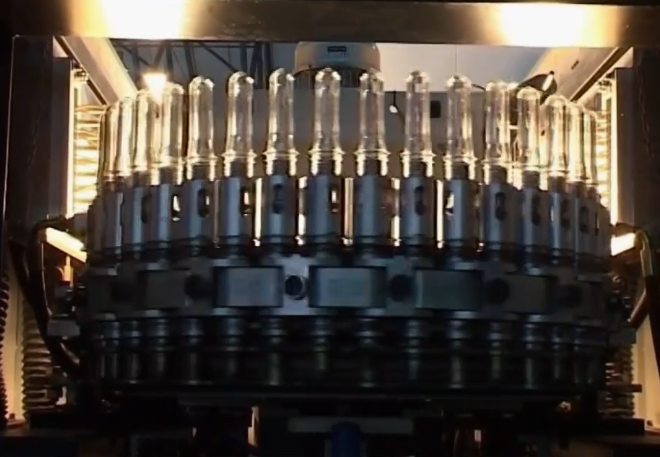
How to Specify a Replacement PET Preform Heating Lamp
Ordering replacement infrared lamps for a PET reheat stretch blow moulding machine is often treated as a simple matter of matching wattage. This shortcut frequently results in costly downtime: lamps that do not physically latch into socket spring clips, cold preform shoulders due to mismatched filament lengths, or blown solid-state relays (SSRs) triggered by mismatched cold resistance. To ensure an exact fit and preserve the thermal profile of a qualified bottle, maintenance and procurement teams must specify parameters across four distinct categories: electrical, dimensional, termination, and optical.
1. Electrical Ratings: Beyond Nominal Wattage
A replacement infrared lamp must precisely match the machine’s electrical power distribution bus and SCR/SSR phase-angle controllers.
+ -------------------------------------------------------------------------+
| REQUIRED ELECTRICAL PARAMETERS                                          |
|                                                                         |
| [Rated Voltage (V)]        --> 230 V, 400 V, 480 V (Nominal AC RMS)      |
| [Rated Power (W)]          --> 1000 W, 2000 W, 2500 W, 3000 W           |
| [Connection Configuration] --> Single-phase, Phase-to-Phase (Delta/Star) |
| [Cold Resistance]          --> Measured filament resistance at 20°C     |
+ -------------------------------------------------------------------------+
- Rated Voltage (V): Emitter filament coils are wound for a specific RMS operating voltage (e.g., 230 V, 400 V, or 480 V). Operating a 230 V rated lamp across a 400 V phase will cause immediate filament burnout. Conversely, running a 400 V rated lamp on a 230 V supply reduces radiant flux by more than 65%, shifting the spectrum toward inefficient long-wave infrared.
- Rated Wattage (W): Wattage dictates total thermal energy output at 100% control modulation.
- Cold vs. Hot Resistance: Tungsten filaments exhibit a positive temperature coefficient of resistance (PTC). Cold resistance (at room temperature) is typically 1/10th to 1/15th of the hot operating resistance. Providing the OEM part number or verifying filament design ensures the initial inrush current does not trip circuit breakers or damage SCR modules.
2. Critical Dimensional Verification
Never rely on a single “length” figure from an invoice. A quartz emitter possesses several distinct mechanical dimensions:
| Dimension Code | Parameter Name | Measurement Benchmark | Failure Risk If Mismatched |
|---|---|---|---|
| OAL | Overall Length | Tip-to-tip of ceramic end caps or contact blades | Will not latch into oven cassette sockets or cannot close terminal covers |
| HL | Heated Length (Filament) | Length of the coiled active tungsten filament | Under-heats preform base or overheats neck finish |
| OD | Quartz Outer Diameter | Caliper measurement across clear quartz body (typically 10 mm, 12 mm, or 19 mm) | Interferes with lamp retention clips or external parabolic reflectors |
| CL | Cold End Length | Unheated space between pinch seal and filament start | Thermal shadowing at preform extremities |
| When measuring a broken or sample lamp, place it on a flat layout table with a rigid steel rule. Photograph the entire lamp alongside the rule, focusing on the transition between the glowing coil and the internal molybdenum lead strip. |
3. Base Termination and Mounting Interfaces
The electrical connection and physical retention style must be documented precisely. Common termination styles in commercial blow moulding ovens include:
- **SK15 (Slotted Ceramic Base with Lead Wire):**Features a ceramic cylindrical sleeve with lateral flat slots designed to slide into spring-loaded oven brackets. A high-temperature PTFE- or fiberglass-sleeved nickel wire extends from the ceramic end.
- **R7s (Recessed Single Contact):**Spring-loaded ceramic caps at each end that clip into standard porcelain lamp holders.
- **Flat Metal Blades / Faston Terminals:**Tab terminals designed for direct push-on connectors.
- **Ring or Spade Terminals:**Nickel leads terminating in M4 or M5 eyelets for screw-terminal busbars.
- Note on Burning Position:* Most blow moulding quartz lamps are engineered for horizontal burning ($p15$). Operating a horizontal-design lamp vertically can cause the delicate tungsten filament coils to sag under gravity at high operating temperatures, shorting turns and drastically shortening service life.
4. Optical and Reflector Coatings
Lamps used in PET preform ovens either distribute radiation symmetrically ($360^\circ$) or incorporate an integral directional reflector coating applied directly onto the rear hemisphere of the quartz envelope.
- Clear Quartz (e.g., Goldisgood GIG-010 Series): Radiates $360^\circ$ around the tube perimeter. Relies entirely on external oven mirrors (polished aluminum or gold-plated panels) to redirect backward radiant energy.
- White Ceramic Reflector (e.g., Goldisgood GIG-011 Series): A high-purity white ceramic oxide coating sintered onto the back $180^\circ$ of the quartz tube. It diffuses and redirects up to 85%–90% of back-scattered radiation forward toward the preform track, reducing reliance on tarnished oven back-mirrors.
- Gold Reflector Coating: Sputtered 24K gold mirror coating on the back hemisphere, reflecting over 95% of infrared energy. However, gold layers have lower temperature tolerances and can degrade if oven cooling airflow is restricted.
5. Machine Context and OEM Cross-Referencing
When communicating with replacement lamp manufacturers, providing the blow moulder model and oven cassette series significantly accelerates verification:
- **Machine Make & Model:**Specify machine chassis type (rotary carousel vs. linear indexing), manufacturer series, and oven cassette code.
- **Oven Module Identification:**Linear track vs. rotary pitch; pitch distance between preform mandrels.
- **Original Stampings:**Look for laser etching or ink stamps on the ceramic end caps (e.g.,
400V 2500W, manufacturer batch codes).
6. The Complete Procurement RFQ Checklist
Before submitting an inquiry, copy and complete this data verification table:
===================================================================
PET BLOW MOULDING REPLACEMENT HEATER SPECIFICATION SHEET
===================================================================
1. Operating Voltage:         [       ] Volts AC (RMS)
2. Rated Wattage:             [       ] Watts
3. Overall Length (OAL):      [       ] mm (+/- 1.5 mm)
4. Heated Length (HL):        [       ] mm (+/- 3.0 mm)
5. Quartz Tube Outer Dia:     [       ] mm (e.g., 10mm, 12mm)
6. Base / Termination Style:  [       ] (e.g., SK15, R7s, Lead wire)
7. Lead Wire Length (if any): [       ] mm (Measured ceramic to tip)
8. Lead Terminal End:         [       ] (e.g., Stripped, M4 Ring, Spade)
9. Reflector Coating:         [       ] (Clear / Half-White / Half-Gold)
10. Operating Position:       [       ] (Horizontal / Vertical)
11. Machine OEM & Model:      [       ]
12. Existing Part Markings:   [       ]
===================================================================
Related Guides
- Overall Length vs. Heated Length in PET Infrared Lamps
- Clear vs. Reflector Lamps in PET Reheating: What to Compare
- PET Preform Heating Zones Explained
Related Goldisgood Heating Solutions & Procurement Support
To eliminate fitment mismatches and simplify replacement lamp ordering, Goldisgood provides standard and customized quartz infrared emitters matched to blow moulding oven cassettes:
- **GIG-010 Clear Short-Wave Quartz Series:**Standard industrial single-tube emitters with customizable heated lengths and cold ends. View Specifications on Goldisgood
- **GIG-011 Directional White Reflector Series:**Half-coated ceramic oxide emitters with integrated SK15 ceramic alignment bases. View Specifications on Goldisgood
- **Fast-Track RFQ Specification Verification:**Send your sample lamp dimensions, operating voltage/wattage, and socket photos to our technical sales team at
info@goldisgood.comfor immediate drawing confirmation and cross-referencing.
Sources & References
- International Electrotechnical Commission (IEC) 62798 / DIN EN 62798: Industrial Infrared Emitters - Test Methods for Measuring Performance Characteristics.
- Institute of Electrical and Electronics Engineers (IEEE) Industry Applications Society: Standard Practices for High-Density Quartz Infrared Heating in Industrial Processing.
- National Electrical Manufacturers Association (NEMA): Standard MG 1 & Terminal Integrity in High-Temperature Industrial Assemblies.
- Goldisgood Technical Specification: GIG-010 & GIG-011 Infrared Emitter Specification and RFQ Standards.