Detailed Explanation of Blow Molding Machine Process History and Working Principles
1. Development History of the Blow Molding Process
Hollow blow molding originated from traditional glassblowing techniques. In the late 1930s, with the emergence of synthetic polymers, plastic blow molding technology officially entered the industrial arena.
- Industrial Beginnings (1930s–1940s): In 1938, inventors Enoch Ferngren and William Kopitke validated the feasibility of plastic blow molding, built the world’s first commercial hollow blow molding machine, and transferred the technology to the Hartford-Empire Company. During World War II, driven by wartime demand for medical and military supplies, low-density polyethylene (LDPE) began to be mass-produced into portable vials, marking the beginning of practical applications for hollow plastic containers.
- Industrial Scale Expansion (1950s–1970s): In the late 1950s, the successful synthesis of high-density polyethylene (HDPE) and the advent of dedicated extrusion blow molding equipment spurred the explosive proliferation of the blow molding process. The volume of industrial containers rapidly expanded from small-to-medium reagent bottles to thousand-liter chemical drums, and electronic and automated control systems gradually replaced primitive manual operations.
- Biaxial Orientation and the PET Beverage Packaging Revolution (1970s–Present): Breakthroughs in polyethylene terephthalate (PET) materials and the injection stretch blow molding (ISBM) process completely reshaped the packaging industry. In the U.S. soft drink industry, for example, since the introduction of PET bottles in 1977, annual consumption of plastic containers leaped from zero to tens of billions within just two decades, completely replacing traditional fragile, heavy glass containers.
2. Classification of Blow Molding Equipment and Core Process Routes
Hollow blow molding equipment is generally categorized according to parison/preform manufacturing methods and processing flows:
1. Basic Equipment Classification
- Extrusion Blow Molding (EBM): Plastic pellets are melted and plasticized by an extruder screw and directly extruded into a tubular parison. After the mold closes, compressed air is injected to inflate it. Commonly used for materials like HDPE, PP, and PVC; suitable for personal care bottles, chemical drums, lube oil jugs, and medium-to-large hollow products.
- Injection Blow Molding (IBM): A tubular preform with a closed bottom is first produced via an injection unit, and the hot preform is then transferred to a blow mold for inflation. Products feature precise neck dimensions with no bottom pinch-off flash, commonly used for pharmaceutical bottles and cosmetic vials.
- Injection Stretch Blow Molding (ISBM): Building upon the injection-molded preform, this process introduces an axial mechanical stretch rod and biaxial blow stretching. It is the core technology for manufacturing high-strength, high-clarity PET bottles and BOPP containers.
2. Differences Between “One-Step” and “Two-Step” Processes
- One-Step Process: Preform injection molding, thermal conditioning, axial stretch blowing, and final product discharge are completed continuously within a single machine. Preforms do not undergo cooling and reheating, effectively preventing surface scratching. This yields superior clarity and surface finish, making it particularly well-suited for high-cleanliness pharmaceutical bottles, high-end cosmetic containers, and inline operations in small-to-medium beverage plants.
- Two-Step Process: Divided into two standalone stages: “preform injection” and “bottle blowing.” Standard injection molding machines centrally produce, package, and store preforms, while the blow molding shop uses dedicated Reheat Stretch Blow Molding (RSBM) machines to reheat preforms and perform stretch blowing. This model supports “centralized mass production of preforms and distributed flexible blowing/filling,” substantially reducing empty-bottle warehousing and long-distance shipping costs. It is the mainstream industrial solution widely adopted by large beverage and bottled water conglomerates.
3. Standard Molding Process of Extrusion Blow Molding (EBM)
The EBM process primarily shapes products using an extruder screw coupled with an extrusion die head and compressed air. A standard production cycle comprises the following 5 steps:
- **Plasticizing and Parison Extrusion:**Plastic resin is heated, melted, sheared, and plasticized inside the extruder barrel, then extruded continuously and uniformly through the die head to form a molten tubular parison with uniform wall thickness.
- **Mold Clamping and Cut-off:**The blow mold halves close rapidly to clamp the tubular parison, a cutter at the bottom severs it, and the mold pinch-off blocks pinch the parison bottom to form a bottom weld.
- **Inflation Molding, Pressure Holding, and Cooling:**A blow pin (or blow mandrel) enters or seals against the parison neck, injecting compressed air at 0.2–1.0 MPa to rapidly expand the parison against the water-cooled mold cavity walls. Pressure is then maintained for curing and cooling to prevent shrinkage and warpage.
- **Mold Opening and Part Removal:**Once the part has solidified, the mold opens, and an ejector mechanism or robotic take-out arm smoothly removes the hollow container.
- **Trimming and Deflashing:**Excess flash at the neck and pinch-off seam at the bottom is trimmed away (modern blow molding machines are typically equipped with in-mold trimming or inline automated deflashing units) to yield the qualified finished product.
4. Blowing Process and Pneumatic Control of Two-Step PET Blow Molding Machines
Two-step blow molding machines are designed for PET preforms stored at ambient temperature, converting them into high-strength, transparent bottles through thermomechanical reorganization and biaxial orientation. The core operations are divided into “Preheating and Conditioning” and “Stretch Blow Molding”:
[Ambient Preform] ──> [Zoned Infrared Radiant Heating + Neck Cooling] ──> [Mold Entry & Clamping]
                                                                                  │
[Bottle Discharge] <── [Exhaust, Depressurization & Demolding] <── [High-Pressure Final Blow & Hold] <── [Mechanical Stretch + Medium-Pressure Pre-Blow]
1. Preform Preheating (Pre-heating)
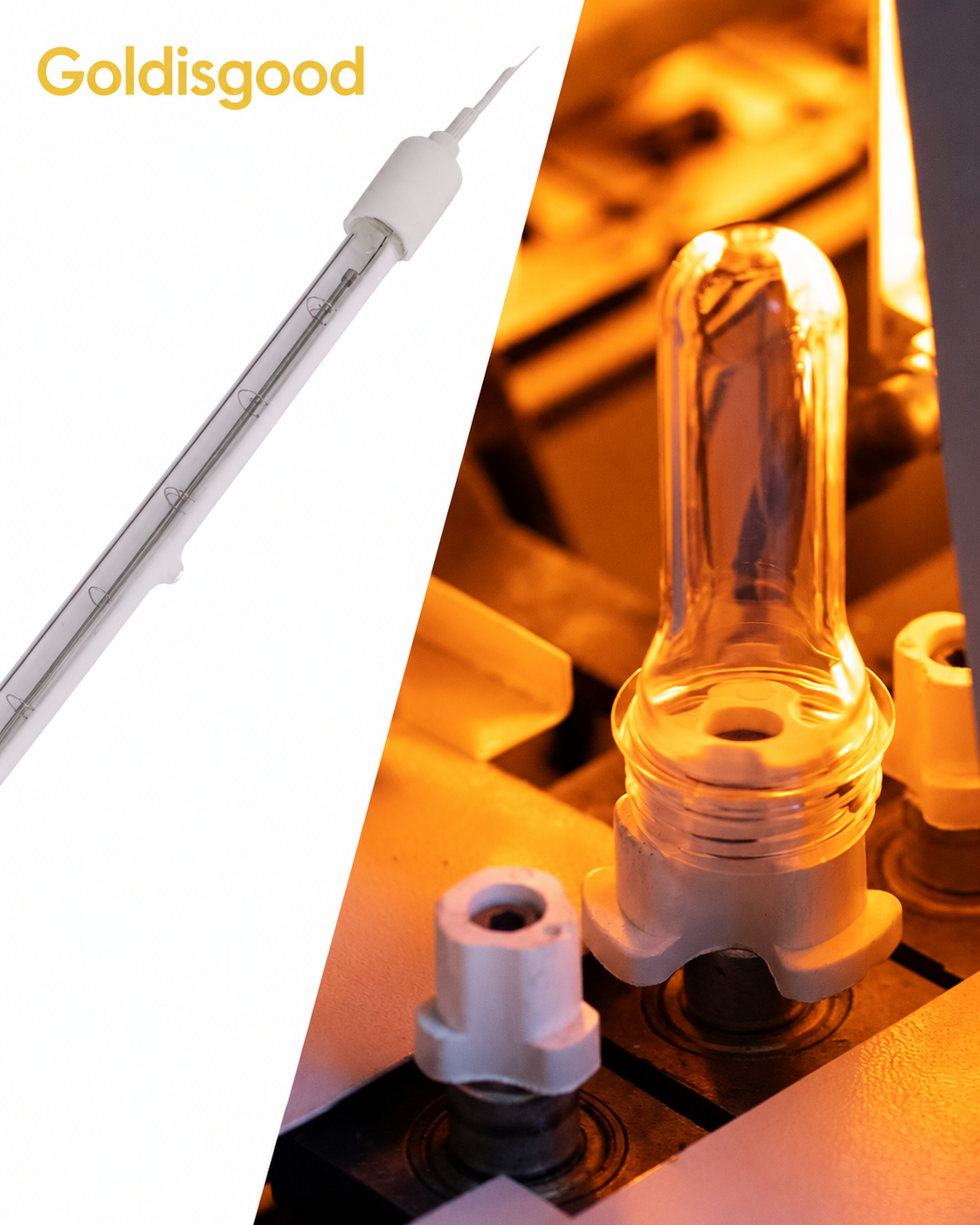
Preforms travel steadily through an infrared heating tunnel on a chain that drives both rotation and revolution. Infrared quartz heating lamps deliver radiant heat to the preform body, raising the PET material’s temperature above its glass transition temperature ($T_g$) but below its melting point ($T_m$) (approx. 90°C–120°C), imparting high rubbery elasticity and formability.
- Neck Cooling Protection: Because the threaded neck must maintain a tight seal with a cap later, it must not deform under heat. The heating zone must be equipped with dedicated water-cooling channels or air-cooled reflector shields to prevent the neck from thermally expanding or losing circularity (ovalization).
2. The 6 Standard Actions of the Mechanical Blowing Cycle
- **Preform Loading:**The preheated, softened preform is transferred into the mold cavity by a mechanical gripper.
- **Mold Closing and Clamping:**A clamping cylinder drives a toggle mechanism to close the mold platens tightly, exerting initial mechanical clamping force.
- **Pressurization and Self-Locking:**A high-pressure clamping airbag or hydraulic auxiliary mechanism applies secondary clamping force, ensuring the mold remains tightly sealed against internal blowing pressures of tens of bars, preventing parting-line flash.
- **Mechanical Stretching and Medium-Pressure Pre-Blowing:**Driven by a pneumatic cylinder or servo motor, the stretch rod moves downward at a constant high speed to mechanically stretch the softened preform axially. Simultaneously, medium-pressure compressed air at 0.8–1.5 MPa is injected for “pre-blowing,” preventing the inner walls from sticking to the stretch rod and expanding the material uniformly in the hoop (circumferential) direction.
- **High-Pressure Final Blowing and Pressure Holding:**As the stretch rod nears the bottom of the mold, the blowing system switches instantaneously to clean high-pressure air at 2.5–4.0 MPa, forcing the softened material firmly against the metal mold walls to form sharp contours and structural ribs, maintaining pressure to rapidly cool and set the product.
- **Exhaust, Depressurization, and Demolding:**High-pressure air inside the mold is rapidly vented to atmospheric pressure through a silenced exhaust circuit; the stretch cylinder and rod retract upward, the mold opens, and a robotic arm grips and discharges the finished bottle.
5. Industry Trends and Technological Evolution
Owing to their light weight, shatter resistance, design freedom, and cost-effectiveness, plastic containers have become a cornerstone in food, beverage, pharmaceutical, and daily chemical packaging. Amid global carbon-reduction initiatives and raw material price volatility, modern blow molding technology is evolving in the following directions:
- **Extreme Lightweighting:**Continuously minimizing unit bottle gram weight while preserving top-load compression strength by optimizing base geometries, stretch-blow ratios, and precision wall-thickness distribution.
- **Energy Conservation and High-Pressure Air Recovery:**Integrating Air Recovery Systems to route exhaust gas from the high-pressure blowing stage back to the pre-blow circuit or the plant’s pneumatic utility lines, reducing the electricity consumed by compressed air generation by 30%–50%.
- **Full Automation and Digital Closed-Loop Control:**Comprehensively adopting servo motor drives to replace traditional pneumatic stretching, achieving micron-level digital control over stretch speed and position, combined with machine vision for 100% inline thickness and defect inspection.