PET Preform Heating Zones Explained
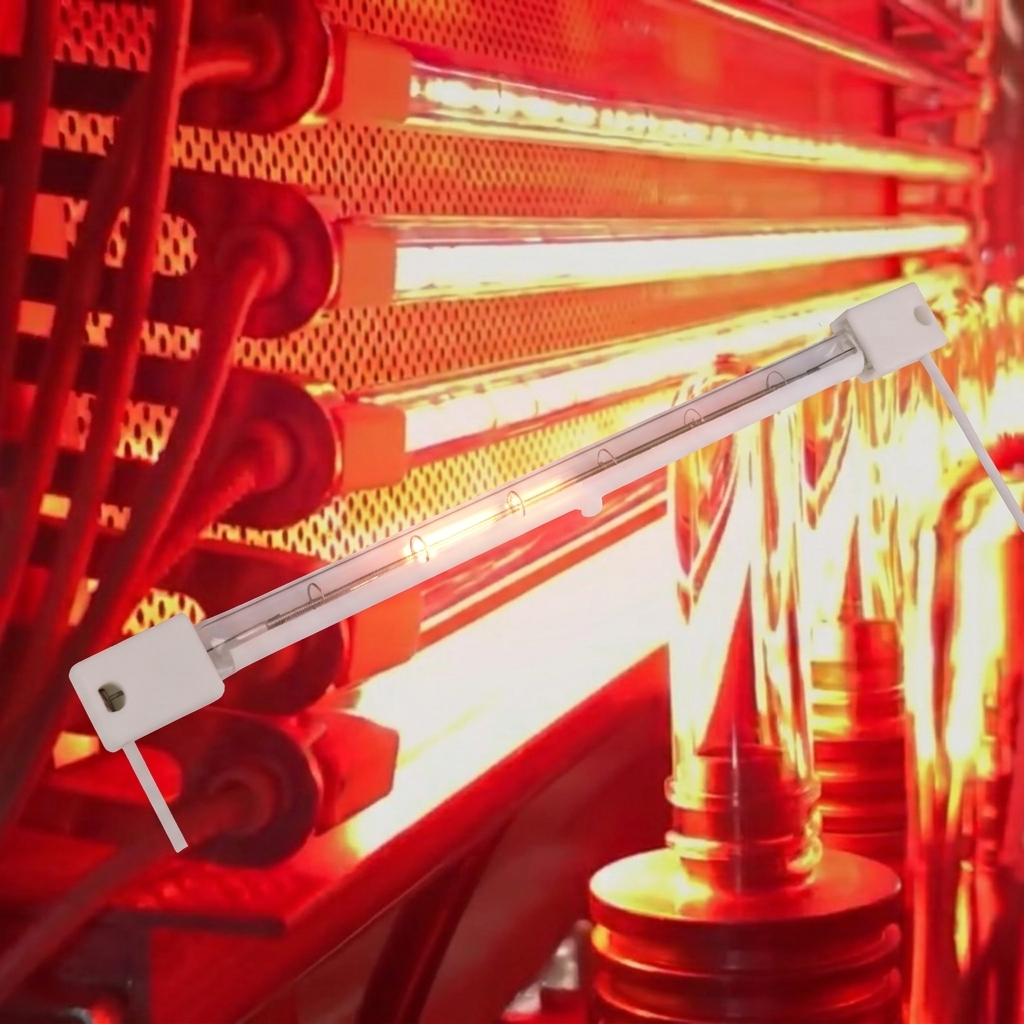
In a reheat stretch blow moulding (SBM) machine, preforms are not heated uniformly along their vertical length. A finished PET bottle requires vastly different amounts of biaxial stretching across its profile: the shoulder must expand rapidly under low resistance, the cylindrical body wall must draw evenly to achieve uniform wall thickness, while the thick injection gate at the base requires sufficient heat to yield without forming an off-center crystalline cluster. To manage this complex thermal demand, blow moulding ovens arrange infrared quartz heating lamps into vertically stacked, independently controlledheating zones.
1. Geometric Mapping: Connecting Lamp Tiers to Container Sections
Preforms enter the oven hanging vertically upside-down (or upright, depending on the machine brand) on rotating transport mandrels. As the preform moves horizontally through the oven tunnel, it passes parallel rows of quartz lamps stacked from top to bottom.
Preform Geometry               Oven Zone Allocation              Stretch Demand & Thermal Target

---

[ Thread Finish ]   =======>   [ Neck Shield / Cooling Duct ]   Maintain <50°C (Rigid, no stretch)
[ Support Ring  ]
[ Shoulder Zone ]   =======>   [ Zone 1 / Top Lamp Tier    ]   High flexibility; smooth transition
[ Body Wall     ]   =======>   [ Zones 2 to 4 / Mid Tiers  ]   Uniform draw ratio; axial orientation
[ Base & Gate   ]   =======>   [ Zones 5 to 6 / Bottom Tier]   Managed yield; prevent unblown thick gate
- **Top Zone (Neck Transition / Under Support Ledge):**Positioned immediately below the water-cooled neck protection rails. This zone controls the bottle neck and shoulder. If this zone is under-heated, high stretching forces cause the bottle neck to neck-in or fold; if overheated, excess resin thins out prematurely, leaving the shoulder weak.
- **Intermediate Zones (Body / Label Area):**These middle lamps (often spanning 2 to 4 lamp positions) supply the primary energy to the body wall. Because this section experiences the highest hoop (circumferential) stretch ratio ($3.5\times\text{–}4.5\times$), temperature consistency directly determines label-panel wall thickness and bottle top-load strength.
- **Bottom Zone (Base and Gate Transition):**Focuses radiation onto the hemispherical base and injection gate. The gate area is inherently amorphous and relatively thick. Insufficient heat leaves a heavy, unblown “slug” of resin at the base, reducing container volume and wasting resin. Excessive heat, however, causes the gate to crystallize, causing micro-voids, haziness, or base burst during hot-fill or carbonated beverage pressurization.
2. Electrical Modulation: How Zones Are Regulated
Each heating zone is connected to a dedicated thyristor (SCR) power controller or solid-state relay (SSR). Operators adjust heating intensity on the machine HMI using percentage setpoints (e.g., Zone 1 at 78%, Zone 2 at 64%, Zone 3 at 55%).
[Overall Oven Power Setpoint %]  ──> Multiplies all zones globally (Line speed / Ambient compensation)
               │
               ├──> [Zone 1 SCR Controller: 78%] ──> Feeds Lamp Tier 1 (Shoulder)
               ├──> [Zone 2 SCR Controller: 64%] ──> Feeds Lamp Tier 2 (Upper Body)
               ├──> [Zone 3 SCR Controller: 55%] ──> Feeds Lamp Tier 3 (Mid Body)
               └──> [Zone 4 SCR Controller: 62%] ──> Feeds Lamp Tier 4 (Base)
- **Global Oven Master Power (%):**Shifts all zones up or down proportionally. Used primarily to compensate for line speed variations or seasonal ambient temperature drift without distorting the relative profile.
- **Individual Zone Setpoints (%):**Alters the vertical thermal distribution curve to shift material distribution upward or downward along the bottle axis.
- Engineering Caveat:* Percentage setpoints do not represent a linear temperature output. Because infrared radiant power follows the Stefan-Boltzmann law ($E \propto T^4$), small percentage adjustments in applied voltage generate non-linear changes in radiant flux and filament color temperature.
3. The Essential Role of Spindle Rotation and Ventilation
Even the most precisely configured vertical zone profile will fail without adequate mechanical rotation and aerodynamic airflow.
Continuous Preform Rotation
Preforms must rotate continuously as they travel past the lamps (typically between 1.5 to 3.0 revolutions per second). If a drive belt slips or a spindle bearing seizes, the preform side facing the lamps overheats while the shadowed side stays cold. This creates a severe circumferential temperature delta ($\Delta T > 8^\circ\text{C}$ around the circumference), resulting in banana-shaped, curved bottles upon blowing.
Boundary Layer Ventilation
Radiation delivers heat directly into the preform wall, but it also heats the outer air layer. Blow moulding ovens employ forced ventilation blowers that push ambient or conditioned air through perforations between lamp reflectors. This air strips away stagnant superheated air from the preform exterior, maintaining the outer surface below the crystallization threshold while infrared photons penetrate into the core.
4. What to Record Before Altering Zone Settings
When troubleshooting material distribution or container defects, technicians frequently make hasty zone adjustments, obliterating the qualified baseline. Before touching any zone setpoint, collect the following data:
| Parameter Category | Specific Information to Log | Purpose |
|---|---|---|
| Oven Recipe Baseline | Current setpoint % for every individual zone and global master | Preserves the recovery point |
| Preform Temperature Profile | Infrared pyrometer readings at the shoulder, mid-body, and base | Establishes actual thermal response |
| Blown Bottle Wall Thickness | Sectioned bottle weights or ultrasonic wall thickness measurements | Identifies exactly where material is accumulating |
| Lamp Integrity | Visual check of all active emitters (no unlit lamps or sagging filaments) | Confirms electrical continuity |
| Cooling Air Pressure | Differential pressure manometer reading across oven ventilation ducts | Verifies surface cooling consistency |
| Adjust only one zone at a time, allowing the machine to cycle through at least two complete oven rotations (typically 3 to 5 minutes) before evaluating the effect on blown bottle wall thickness. |
Related Guides
- How Infrared Heating Works in PET Preform Reheating
- Neck-Finish Cooling in PET Preform Reheating
- Uneven PET Preform Heating: What to Check
Related Goldisgood Heating Solutions & Oven Zone Optimization
Balancing vertical oven zones requires infrared emitters with precise filament positioning and repeatable radiant output:
- **Precision Filament Alignment (GIG-010 Series):**Tightly wound tungsten filaments ensure uniform radiant flux across individual preform body and shoulder zones. View Specifications on Goldisgood
- **Directional Ceramic Reflector Lamps (GIG-011 Series):**Focus radiant energy directly onto target preform elevations, minimizing thermal bleed into adjacent zones. View Specifications on Goldisgood
- **Oven Cassette Audits:**If your line is experiencing vertical heat balance shifts across shifts, consult Goldisgood technical specialists at
info@goldisgood.comfor cassette configuration reviews.
Sources & References
- Polymer Processing Society (PPS): Conference Proceedings on Biaxial Stretching and Axial Temperature Profiles in ISBM.
- Society of Plastics Engineers (SPE) ANTEC: Optimization of Temperature Distribution in Stretch Blow Molding of PET Containers.
- Fraunhofer Institute for Applied Polymer Research: Thermal Flux Analysis in Vertical Infrared Heating Zones.
- Goldisgood Technical Specification: Quartz Infrared Emitter Tier Configuration Standards.